
CBO vs ABO in 2026: when each still wins
CBO won the argument years ago and mostly deserved to. But "mostly" is doing real work in that sentence — and the cases where ABO still wins are the cases where you're trying to learn something.
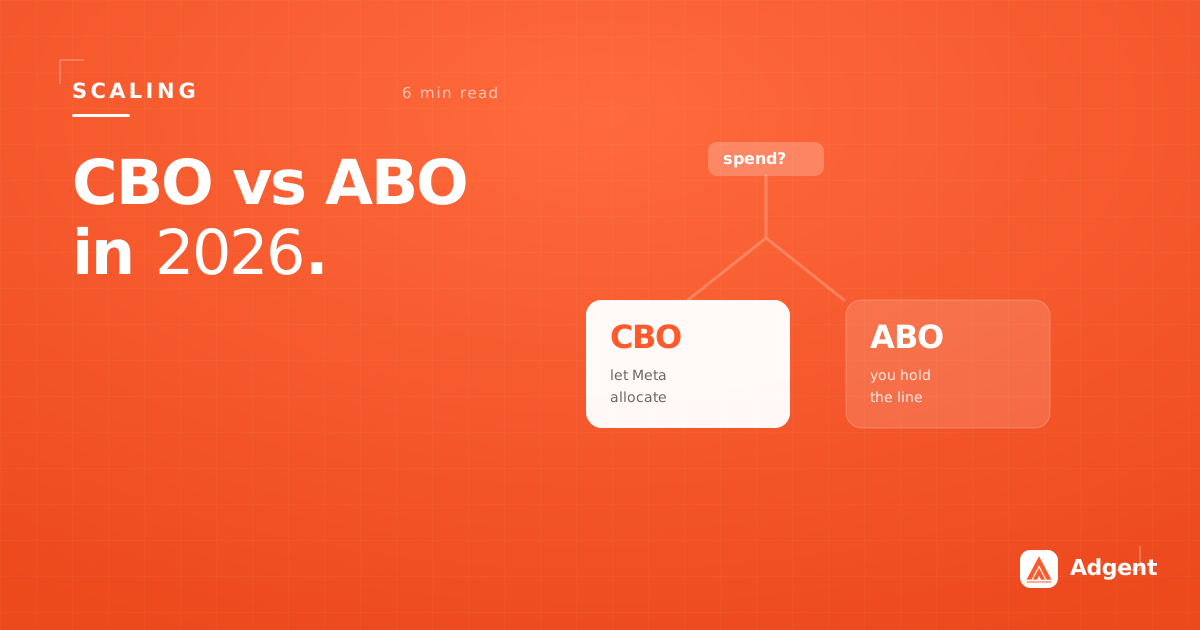
Use CBO when you're scaling a known winner with healthy volume and comparable ad sets — let Meta allocate. Use ABO when you're testing audiences, creatives or offers, running under ~50 conversions a week, or mixing ad sets with different jobs, because it guarantees each one a fair sample. CBO buys efficiency; ABO buys answers.
Ask ten media buyers whether to use campaign budget optimization and nine will say yes without asking what you're doing. They're right often enough that the tenth answer never gets heard — which is a shame, because the tenth answer is where the interesting accounts live.
What CBO is actually good at
CBO — now Advantage campaign budget — pools your budget at the campaign level and lets Meta allocate it across ad sets in real time. When it works, it works for a real reason: the algorithm sees auction dynamics at a resolution and frequency no human can match. It's rebalancing continuously while you're asleep.
It needs two conditions to do that well: enough conversion volume for the signal to be trustworthy, and comparable ad sets so the comparison it's making is a fair one. Give it both and it will beat your manual allocation reliably.
CBO optimizes for the campaign's total result. If what you need is an answer about one ad set, it will efficiently deny you that answer.
Where CBO quietly fails you
The failure isn't that CBO underperforms. It's that it does its job so well it destroys your ability to learn anything.
Put five audiences in a CBO and Meta will find the cheapest one quickly and starve the other four. You'll see one ad set with the overwhelming majority of the spend and four with statistical dust. Now answer: were those four audiences bad, or did they just never get a fair trial? You can't know. The system optimized away the experiment you were trying to run.
The same dynamic bites when your ad sets aren't comparable. A €200 cold prospecting set and a €20 retargeting set in the same CBO isn't an allocation decision — it's a rigged comparison. Retargeting will always look cheaper, CBO will always feed it, and you'll wake up to an account that's stopped acquiring anyone new.
The decision tree
Skip the ideology. Ask what you're doing:
- Scaling a known winner, healthy volume, similar audiences? CBO. Let the machine do what it's better at than you.
- Testing audiences, creative angles, or offers? ABO. Buy each one a guaranteed sample. You're paying for an answer, not for efficiency.
- Ad sets with genuinely different jobs — prospecting next to retargeting? ABO, or separate campaigns. Never make the algorithm choose between two things you need both of.
- Under ~50 conversions per week campaign-wide? ABO. There isn't enough signal for CBO to allocate on, so it's guessing with your money.
The structure most good accounts land on
In practice the answer is usually both, separated by purpose. ABO campaigns for testing, where you're buying information and want each option to get a fair shot. CBO campaigns for scaling, where you've stopped asking questions and want efficiency. Winners graduate from the first into the second.
Which means the real skill isn't picking a structure — it's noticing when an ad set has finished being an experiment and become a known quantity. That's a judgment call about statistical maturity, and it's the one Adgent makes each morning: which tests have concluded, which are still running, and which have been starved of the data they needed to conclude at all.
CBO isn't better than ABO. It's better at a different job. Knowing which job you're doing is the whole answer.
Does CBO actually scale better? The volume question
The strongest case for CBO is scale, and it's a real case — but only above a threshold most people don't check before they flip the switch. CBO's edge comes from having enough conversion signal to reallocate on. Below roughly 50 conversions per week campaign-wide, the algorithm is making high-stakes decisions on a handful of events, and the variance in that little data will send your budget chasing noise. It'll pile spend onto whichever ad set got lucky on Tuesday, then yank it away on Thursday, and you'll mistake that thrash for optimization.
Above the threshold, CBO scales genuinely better than manual allocation because it's rebalancing at a frequency and resolution you can't. But "scales better" is conditional on the ad sets being comparable — same funnel stage, same optimization event, roughly similar economics. Hand CBO a healthy volume of look-alike ad sets and it will outrun your spreadsheet every time. Hand it volume plus a €200 prospecting set sitting next to a €20 retargeting set and it will scale you straight into a wall, pouring budget into cheap retargeting until you've stopped acquiring anyone new. Volume is necessary for CBO to win. It's never sufficient on its own.
Migrating from ABO to CBO without resetting learning
You can move a campaign from ABO to CBO, and the right moment to do it is specific: when an ad set has stopped being an experiment and become a known quantity. A winner that's cleared its testing phase — stable CPA, enough conversions to trust, a creative that isn't fatiguing yet — is ready to graduate into a CBO built for efficiency. The mistake is switching before the answer is in, which throws away the fair trial ABO was buying you.
Two practical cautions on the switch itself. First, changing budget structure is an edit Meta treats as significant, and it can briefly re-enter a learning phase — so migrate when you can absorb a few unstable days, not the week before a launch. Second, don't dump three freshly-tested winners of very different scale into one CBO and expect a fair split; the same comparability rule that governed the test governs the scale campaign. Group like with like. If you're carrying a proven winner across the line, the mechanics of doing it without spooking the algorithm are their own discipline — see how to scale a winner without breaking it.
The same decision on Google, and why attribution decides it
The CBO-versus-ABO instinct isn't Meta-only. On Google the equivalent tension is Performance Max — which pools budget and hides the structure the way CBO does — against tightly-scoped campaigns you can actually read. Performance Max is CBO's logic taken further: maximum delegation, minimum visibility. It's the right tool once you trust the signal and wrong the moment you're trying to learn where results are actually coming from, because it will happily credit itself for demand you already owned.
Underneath both platforms sits the same unglamorous decider: attribution. CBO and Performance Max are only as smart as the conversion signal you feed them, and if that signal is inflated — view-through credit dressed up as incremental, a number still moving inside its attribution window, a blended ROAS hiding a placement leak — then automated allocation doesn't fix the problem, it scales it. The budget flows toward whatever looks cheapest on paper, which is often whatever is best at claiming credit rather than creating it. Before you trust any budget-pooling structure to allocate for you, the question isn't "CBO or ABO" — it's "do I believe these numbers enough to hand over the wheel?" That check, run every morning across Meta and Google as one account, is the job Adgent does before it ever recommends a structure.
The structure question sits on top of a measurement question: automated allocation is only as good as the conversion signal underneath it, and an inflated signal gets scaled rather than corrected. Adgent runs that check across Meta and Google as one account each morning — flagging view-through credit dressed up as incremental, numbers still moving inside their window, and averages hiding a leak — before it recommends any structure. If you want to know whether your numbers are solid enough to pool a budget on, request a demo — one real finding on your own account, before you change anything.
Frequently asked
When should I use CBO vs ABO?
Is CBO better than ABO?
When does ABO win?
Does CBO scale better?
How do I choose between CBO and ABO?
Can I switch from ABO to CBO?
Adgent reads Meta and Google accounts overnight and hands you one brief each morning — the diagnosis, the evidence from your own account, and a change you approve before anything writes. Read-only by default. It analyzes creative; it doesn't make it.