
How to scale a winner without breaking it
You found a campaign that works. Now the hard part: adding budget without handing it back to the learning phase. The rule isn't about how much you add — it's about how fast.
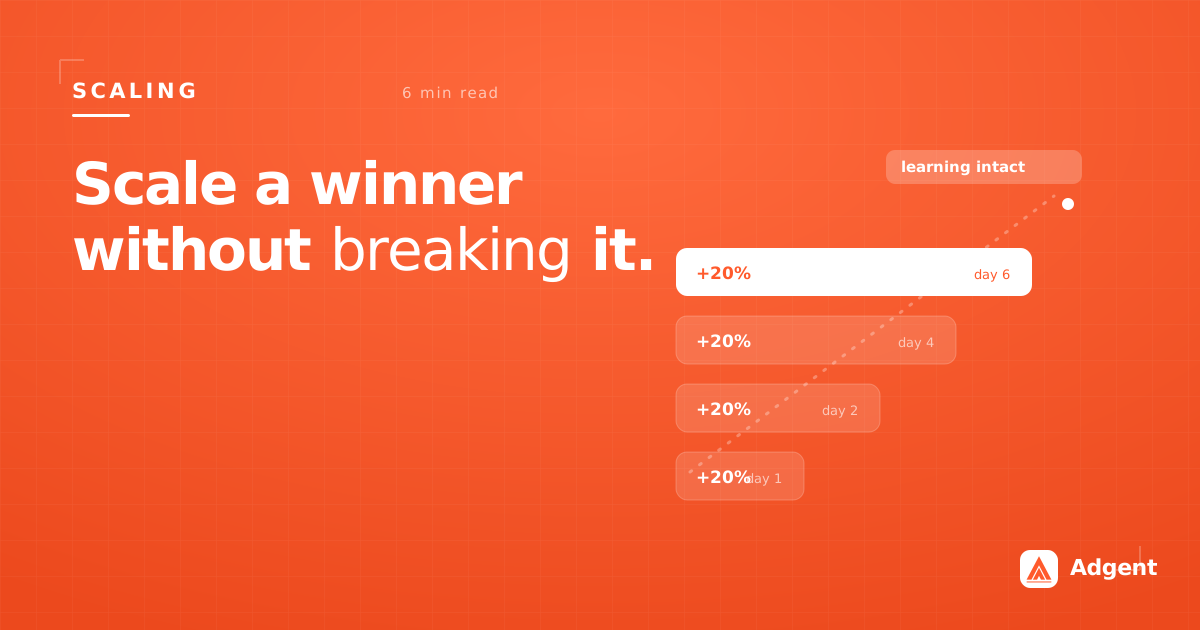
To scale a Meta campaign without a learning reset, raise the budget by no more than ~20% every 48–72 hours instead of one big jump. Meta re-enters the learning phase when a budget change is large enough to count as a material edit — so it's the size of the delta, not the final number, that triggers the reset. Scale in small steps and the ad set keeps everything it learned.
Every performance marketer knows the feeling. A campaign hits 4× and you want more of it — so you triple the budget overnight. By Thursday it's at 1.8× and you're trying to work out what broke. Nothing broke. You reset it.
What a budget change actually does
Meta's delivery system treats a significant budget change as a material change to the ad set. Cross the threshold and the ad set re-enters the learning phase, where it needs roughly 50 conversions in 7 days to stabilize again. Everything it learned about who converts gets re-litigated — and while it re-learns, your cost per result climbs.
You didn't buy more of a working campaign. You bought a new campaign wearing its name.
This is the trap in scaling: the thing you're scaling stops being the thing that worked the moment you scale it hard enough.
The 20% rule, and what it's really about
The widely-used heuristic is to raise a budget by no more than about 20% every 48–72 hours. It works, but the reason matters more than the number. You're not avoiding a big budget. You're avoiding a big delta. An ad set at €100/day can reach €500/day in about three weeks of 20% steps without ever tripping a reset. Jump there in one move and you've thrown away three weeks of learning to save three weeks of waiting.
When to go sideways instead of up
Vertical scaling — more budget into the same ad set — eventually hits a ceiling that has nothing to do with learning phases. You saturate the audience. Frequency climbs, CPM follows, and each extra euro buys a worse impression than the last.
At that point the move is horizontal: duplicate into a new audience, a new placement mix, or a new geo, and let the winning creative do its work against fresh eyeballs. The signals that tell you the ceiling is close:
- CPM rising while CTR holds. You're paying more for the same interest — the auction, not the creative, is the constraint.
- Frequency past ~2.5 in a 7-day window. On a cold prospecting audience, that's saturation, not reach.
- Incremental spend at falling marginal ROAS. The blended number still looks fine while the last €1,000 returns nothing. Read the margin, not the average.
Why ROAS crashes the moment you scale hard
A hard scale rarely fails for one reason — it fails for three at once, and they compound. The first is the reset itself: the ad set is re-learning, so delivery is deliberately exploratory and inefficient while it hunts for 50 conversions. The second is auction pressure. To spend three times the budget, Meta widens delivery into more expensive inventory and higher-competition slots — CPM climbs before your creative gets a fair test. The third is measurement lag: the ROAS you scaled on may still have been inside its attribution window, so the "4×" you were chasing was never fully real to begin with.
Stack those together and the crash looks mysterious. It isn't. You changed the campaign, made it more expensive to run, and did it on a number that hadn't matured. The fix isn't a better bid strategy — it's slowing down enough that only one variable moves at a time. If you're not sure the ROAS was solid before you scaled, that's usually an attribution-window problem, not a scaling problem.
CBO, Advantage+, and where budget lives when you scale
Where you push the budget matters as much as how fast. Under ABO, you're editing an ad set directly, so a large increase maps cleanly onto a single learning phase — the 20% rule applies exactly as written. Under CBO (and Advantage+ campaign budgets), you're raising a shared pool that Meta redistributes across ad sets on its own logic. A big campaign-level jump can quietly re-open learning on several ad sets at once, or starve the ad sets that were actually carrying performance.
The safer pattern at the campaign level is the same principle, applied to the pool: step the campaign budget up gradually and watch how Meta reallocates before you add more. If you're deciding between the two structures while you scale, the trade-offs are worth reading in full — we covered them in CBO vs ABO in 2026. And regardless of structure, don't stack a budget change on top of a creative swap or an audience edit on the same day — every simultaneous change is one more variable you can't isolate when the number moves.
A practical scaling cadence
Here's the loop that holds up across an account, not just one lucky ad set. Confirm the winner is real first: enough conversions to be out of the learning phase, and a ROAS that has cleared its attribution window rather than a day-one spike. Then raise the budget ~20%, and leave it alone for a full 48–72 hours so the ad set can restabilize before the next step. Repeat only while the marginal ROAS on the last increase still holds.
When vertical steps start returning less each time — CPM up, frequency past ~2.5, marginal ROAS sliding — stop climbing and go sideways: duplicate the winning creative into a fresh audience, placement mix, or geo. Horizontal scaling resets the saturation clock without resetting the learning you paid for. The discipline is boring on purpose: one change, then wait, then read the result — the opposite of the overnight triple that started this post.
The part nobody automates well
The rules above are easy to write down and hard to hold across thirty ad sets on a Tuesday. Scaling decisions are judgment calls that need three things at once: how long since the last change, where the ad set is in its learning phase, and whether the ROAS you're scaling on has actually matured.
That's the reasoning Adgent runs every morning. It knows when each ad set last changed, which ones are clear of the learning phase, and which winners have headroom left — and it proposes the step, waits for your approval, then executes. The judgment is the product; the click is the easy part.
Scaling well is mostly patience with a system that punishes impatience. Add slowly, and you keep what you built.
The rules are easy to write down and hard to hold across thirty ad sets on a Tuesday, because each decision needs three facts at once: time since the last change, learning-phase state, and whether the ROAS you are scaling on has matured. Adgent keeps all three and proposes the step — you approve it before anything moves. If you want to see which of your winners still have headroom, request a demo — one real finding on your own account, before you change anything.
Frequently asked
How fast can I scale a Meta campaign?
What is the 20% rule?
Does increasing budget reset the learning phase?
When should I scale horizontally instead of vertically?
How much budget increase is safe?
Why does my ROAS crash when I scale?
Adgent reads Meta and Google accounts overnight and hands you one brief each morning — the diagnosis, the evidence from your own account, and a change you approve before anything writes. Read-only by default. It analyzes creative; it doesn't make it.