
What is an AI media buyer?
The term is new, the job isn't. An AI media buyer reads your ad accounts like a senior strategist, tells you what to do and why, and makes the change on your approval — not a dashboard with a chatbot bolted on.
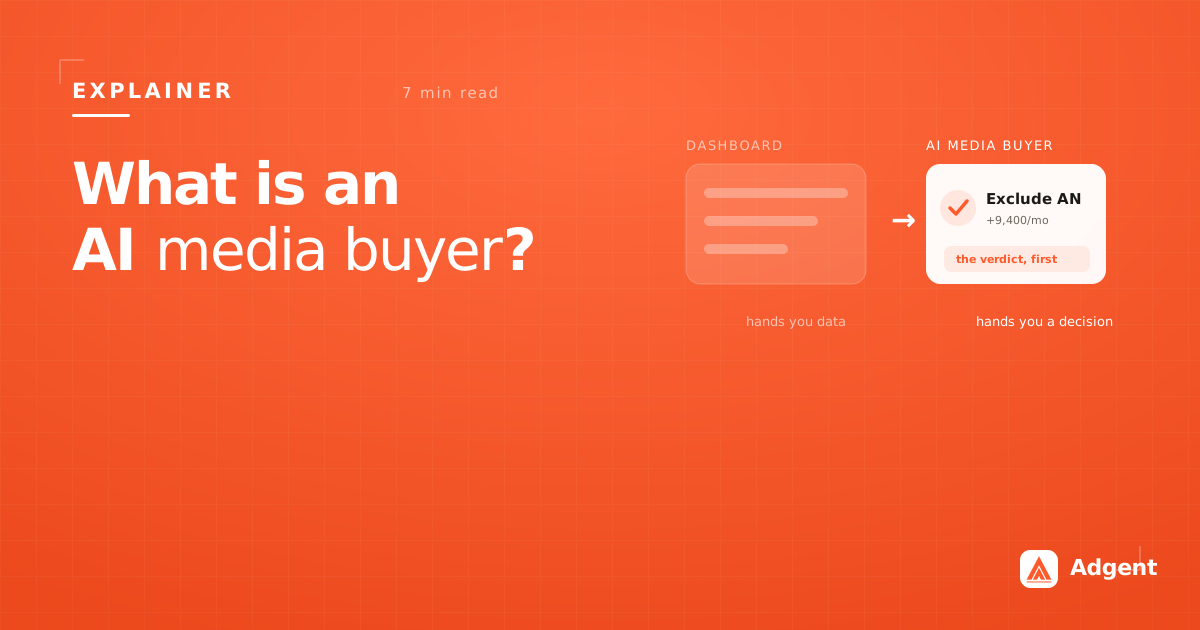
An AI media buyer is software that reads your ad accounts like a senior strategist — reasoning about account structure, pacing, creative fatigue and attribution — then tells you what to do and why, and executes the change on your approval. Unlike a dashboard, it commits to a conclusion; unlike platform automation, it works for the advertiser, not the auction. The best ones stay read-only by default and are never autonomous spenders.
Search "AI media buyer" and you'll find two kinds of answer: hype that promises to "replace your team," and tools that are really just dashboards with a chat box. Neither describes the job. So here's a plain-language definition, and an honest map of what the category actually contains.
The short definition
An AI media buyer is software that does the reasoning part of a media buyer's job. It reads your ad accounts across platforms, reasons about how they're built — budget structure, placements, audiences, creative, attribution — and commits to a conclusion about what to change and why. Then it prepares the change and executes it when you approve.
The word that matters is reasoning. A media buyer's value was never pulling the numbers; it was knowing which number matters today, why it moved, and what to do about it. That judgment is the thing an AI media buyer automates — the click at the end is the easy part.
A dashboard hands you data. An AI media buyer hands you a decision.
What it is not
The category gets muddy because three very different things get called "AI for ads." They're worth separating:
- Not a reporting dashboard. A dashboard renders your data beautifully and leaves the analysis to you. The decision is still yours to make, alone, at 8am.
- Not platform automation. Meta Advantage+ and Google Performance Max are the platforms' own AI — and they optimize toward the platform's auction, not your margin. An AI media buyer sits on your side of the table.
- Not a rules engine. "If CPA > X, pause" is automation without judgment. It fires on a threshold; it can't tell you why CPA moved or whether pausing is the right call.
AI media buyer vs. dashboard vs. platform AI vs. rules
The fastest way to place the category is side by side. Here's how an AI media buyer differs from the three things it gets confused with, across the capabilities that actually matter:
| Capability | Reporting dashboard | Platform AI (Advantage+, PMax) | Rules engine | AI media buyer |
|---|---|---|---|---|
| Reasons about why a metric moved | — | — | — | ✓ |
| Reads across Meta & Google as one | partial | — | — | ✓ |
| Works for the advertiser, not the auction | ✓ | — | ✓ | ✓ |
| Cross-checks against real revenue | partial | — | — | ✓ |
| Executes the fix | — | ✓ | ✓ | ✓ |
| Waits for your approval before writing | n/a | — | — | ✓ |
| Explains its confidence and flags bad data | — | — | — | ✓ |
The column on the right is the whole reason the category exists: judgment and execution, on the advertiser's side, with the human still holding the last click.
How the category got here: manual → rules → platform AI → AI media buyer
The job didn't appear overnight. It's the fourth step in a twenty-year arc, and each step automated a different layer while leaving the hardest one — judgment — to a human:
- Manual buying. A person set every bid, budget and audience by hand. Total control, zero scale.
- Rules & scripts. "If CPA > X, pause." Scale arrived, but the rules were blind to context — they fired on a threshold, never on a reason.
- Platform AI. Advantage+ and Performance Max automated bidding and placement — but optimized toward the platform's auction, and hid the account structure from the buyer.
- AI media buyer. The first layer that automates the reasoning — reads the whole account, commits to a conclusion, explains it, and executes on approval. It works for you, not the auction.
What a real one does, day to day
Strip away the marketing and the job breaks into one loop with three moves — Aware, Ask, Apply. A capable AI media buyer runs all three:
Aware — it watches, and writes the verdict first
Overnight it reads every account across Meta and Google as one book, builds baselines, and detects what changed. In the morning you get a brief ranked by impact, not a wall of charts. This is the same principle behind why we lead with the verdict: conclusion first, evidence underneath.
Ask — it answers, in plain language
You ask "why did Meta ROAS drop yesterday?" and get a strategist's answer with evidence, not a chart to decode. That includes the awkward truths a dashboard glosses over — like a blended ROAS hiding a placement leak, or a number that's still inside the attribution window and shouldn't be trusted yet.
Apply — it acts, on your approval
When a fix is ready, it's a prepared action you approve with one message. Nothing writes to a live account on its own. Read-only by default is the whole point: the judgment is automated, the control stays with you.
Why the honest version matters
The reason to be careful about the definition is trust. An AI media buyer touches real client money, so the version worth using is the one that knows the limits of its own numbers — it flags a metric it can't stand behind instead of printing a confident figure. "Impressive but wrong" is worse than useless when there's spend on the line.
The test that separates the two is simple: does it ever tell you no? A system that only says yes isn't reasoning, it's executing. On a real account, ours declined a target CPA an order of magnitude below anything the account had ever produced, and refused to treat a pixel with four purchases in thirty days as ready for a conversion campaign. Each time it showed the account's own numbers as the reason. That is the job. Automation that can't decline is just a faster way to be wrong.
Should an AI media buyer be fully autonomous?
Most of the category markets on autonomy — "set it and forget it," "replaces your team." It's the wrong promise, and it's worth saying plainly why.
Advertising isn't a closed game with a fixed reward. Attribution windows revise numbers for a week; a conversion event can be mis-configured so ROAS is literally unmeasurable; a promising placement can be view-through credit in disguise. A system that acts autonomously on those numbers doesn't remove risk — it removes the human who would have caught the bad number. The judgment should be automated. The last click should not.
So the better design is read-only by default with approval-gated execution: the AI does the analysis, ranks by impact, states its confidence, prepares the change — and waits. You get the speed of automation and keep the accountability. That's the difference between an AI media buyer you can put on a client account and one you can only demo.
How to choose an AI media buyer
If you're evaluating tools in this category, five questions separate the real ones from the dashboards-with-a-chatbot:
- Does it reason, or just report? Ask it "why did this move?" — a real one gives a cause, not a chart.
- Is it read-only by default? Anything that writes to a live account without your approval is a liability on client money.
- Does it cross-check against real revenue? Platform-reported ROAS alone isn't ground truth — it should reconcile to GA4, Shopify or your store.
- Does it flag what it can't measure? The honest ones say "this number can't be trusted yet" instead of inventing confidence.
- Does it work across channels as one account? Meta and Google read together, not three separate tools bolted side by side.
That's the bar we build Adgent to: a senior media buyer's judgment across Meta and Google, honest about what it can and can't measure, executing only on your word. If you want to see what it would say about a real account, request a demo — one real finding on your own account, before you change anything.
Frequently asked
What is an AI media buyer?
How is an AI media buyer different from a dashboard?
Is an AI media buyer the same as Meta Advantage+ or Google Performance Max?
Does an AI media buyer change campaigns automatically?
Does an AI media buyer replace a media buyer?
How is an AI media buyer different from programmatic advertising?
What channels does an AI media buyer cover?
Is an AI media buyer safe to use on client accounts?
Adgent reads Meta and Google accounts overnight and hands you one brief each morning — the diagnosis, the evidence from your own account, and a change you approve before anything writes. Read-only by default. It analyzes creative; it doesn't make it.