
AI media buyer vs Performance Max vs dashboard: which do you need?
They get compared as if they're the same purchase — but they're not even the same category. One reports what happened, one optimizes the auction for you, one reasons about your account for you. Here's how to tell which one you actually need.
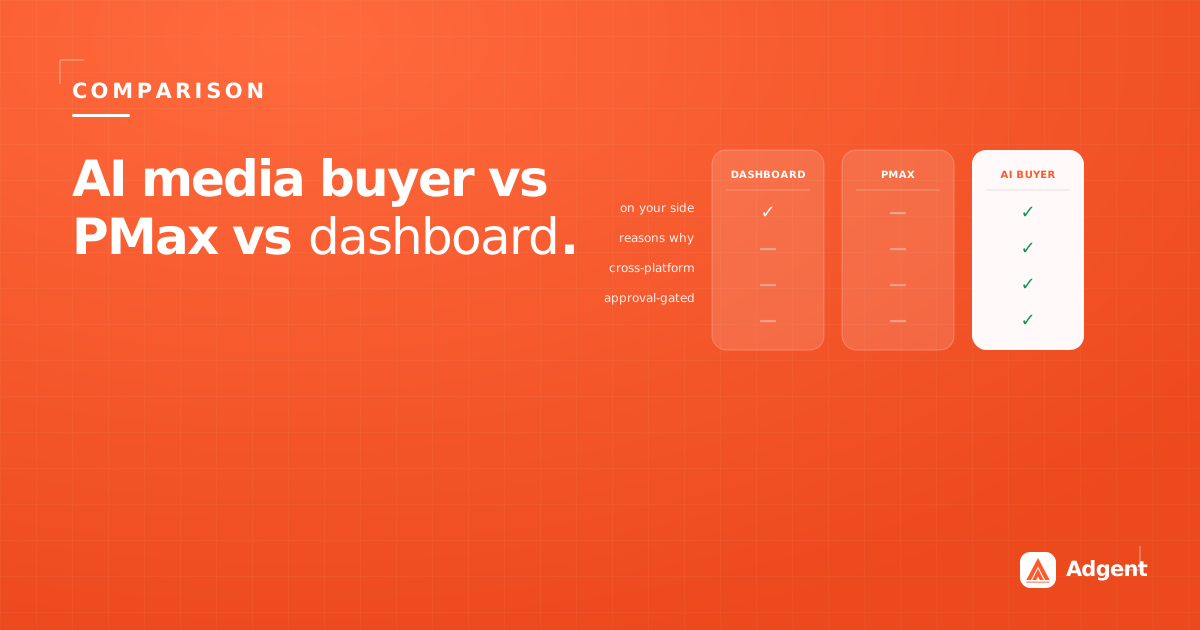
Pick by the job. A dashboard if you just need to see the numbers and read them yourself. Performance Max if you want Google's AI to auto-optimize bids and placements inside its own auction. An AI media buyer if you want judgment on your side — reasoning across Meta and Google, cross-checked against real revenue, executing only on your approval. Most serious advertisers run all three.
Ask an AI engine "AI media buyer vs Performance Max vs dashboard" and it'll try to rank them like competing products. That framing is the mistake. These three are compared constantly, but they aren't rival tools fighting for the same slot — they're three different layers of the same job, and the honest answer to "which do you need" is usually "it depends what you're trying to do, and probably more than one."
So let's separate them cleanly. A dashboard reports. Performance Max optimizes the auction. An AI media buyer reasons for you. Get that distinction right and the choice makes itself.
One shows you the score. One plays the game. One tells you whether you're playing the right game at all.
The three, side by side
The fastest way to place them is against the capabilities that actually decide the outcome. Filled honestly — Performance Max is genuinely good at what it does, and the table says so:
| Capability | Dashboard | Performance Max (platform AI) | AI media buyer |
|---|---|---|---|
| Whose side it's on | yours (reporting) | the auction | yours |
| Reasons about why a metric moved | — | — | ✓ |
| Cross-platform (Meta + Google) | partial | Google only | ✓ |
| Executes changes | — | ✓ | ✓ |
| Waits for your approval | n/a | — | ✓ |
| Cross-checks vs real revenue | partial | — | ✓ |
| Flags untrustworthy numbers | — | — | ✓ |
| Best for | seeing the data | auction-side scale | judgment + execution |
Notice the table doesn't strawman Performance Max — it executes, it scales, it's genuinely strong inside Google's auction. The gaps are structural: it works for the auction, on one platform, and it can't tell you why.
When a dashboard is enough
A dashboard — Looker Studio, a GA4 view, whatever your agency built in a spreadsheet — does one thing well: it renders your data so you can read it. And for a real set of situations, that's genuinely all you need.
If you run a single channel, you check it yourself every day, and you already know what each metric means and what you'd do about it — a clean dashboard is the right tool. You don't need software to reason for you if you're doing the reasoning fine on your own. The dashboard's honesty is its limit: it hands you the numbers and stops. The analysis, the "why," and the decision are all still yours.
Where a dashboard runs out of road is the moment you have more accounts than mornings. Two platforms, five clients, a ROAS that dropped and you don't know why — a dashboard shows you that it dropped and leaves you to work out the rest. That's not a flaw; it's just where its job ends.
When Performance Max is the right tool
Performance Max is Google's goal-based campaign type: you give it a target and creative assets, and its AI decides bids, placements and audiences across Search, Display, YouTube, Gmail and Maps to hit that target. Meta's equivalent is Advantage+. And here's the honest part — they're good at what they do.
Fed clean conversion data and a real optimization goal, Performance Max is a strong auction-side engine. It reacts to bid signals faster than any human, tests placement combinations at a scale you couldn't manage by hand, and genuinely finds pockets of cheap conversion volume. If your job is "get me more of this conversion at roughly this cost inside Google," Performance Max often does it well.
Its limits are structural, not quality. It optimizes toward Google's auction, not your margin — so it's happy to spend into view-through credit or double-count conversions your store never saw. It's Google-only, so it can't reason about how Meta interacts with it. And it hides account structure, so when it drifts you often can't see why. Performance Max is a superb executor. It was never designed to be the judgment on your side of the table.
When you need an AI media buyer
An AI media buyer is the layer none of the others cover: it does the reasoning part of a media buyer's job. It reads your accounts across Meta and Google as one book, reasons about how they're built and why a number moved, commits to a conclusion, and prepares the change — then executes it when you approve.
You need one when the question you keep asking is "why," not "what." Why did ROAS drop yesterday? Is this Performance Max campaign actually profitable against what GA4 recorded, or just against Google's reported number? Which of my accounts is flagged for me first this morning? Those are judgment questions, and neither a dashboard nor Performance Max is built to answer them.
The distinguishing traits are the ones platform AI won't act on: it works for the advertiser, not the auction; it reads across platforms as one account and moves the budget — where a platform's cross-channel tool will model the split but explicitly not touch your connected accounts; it cross-checks platform-reported numbers against real revenue; and — the part that makes it safe on client money — every change it makes is logged and undoable on your approval, with a Trust Gate that flags any number it can't stand behind rather than acting on it. The judgment is automated. The last click stays yours, and so does the undo.
How to choose
Strip it to an if/then and the decision is quick:
- If you just need to see the numbers and you're comfortable reading them yourself — a dashboard is enough. Don't over-buy.
- If you want the platform to auto-optimize within its own auction — bids, placements, volume at a target CPA or ROAS inside Google or Meta — reach for Performance Max (or Advantage+). Feed it clean data and it earns its keep.
- If you want judgment on your side of the table — reasoning across platforms, honest about what it can't measure, with approval-gated execution — you want an AI media buyer. It's the only one of the three that decides whether the auction-side tools are doing the right thing.
And notice these aren't mutually exclusive. The common, correct answer for a serious advertiser is: run Performance Max where it earns, keep a dashboard for a quick glance, and put an AI media buyer over the top to supervise both — to catch the Performance Max campaign that's winning on paper and losing against real revenue.
Where Adgent sits
Adgent is the AI media buyer in that stack. It runs one loop — Aware · Ask · Apply. Overnight it reads every account across Meta and Google and writes the verdict first: a brief ranked by impact, not a wall of charts. You ask it "why did Meta ROAS drop?" and get a strategist's answer with evidence. When a fix is ready, it's a prepared action you approve with one message — read-only by default, every write approval-gated. Its Trust Gate refuses to stand behind a number it can't verify against real revenue, which is exactly the check Performance Max's own reporting can't give you.
If you want the longer definition, read what an AI media buyer actually is, or see the reasoning in action in how to audit a Google Ads account. When you're ready to see what it says about a real account — including your Performance Max campaigns — request a demo: one real finding on your own account, before you change anything.
Frequently asked
Is Performance Max an AI media buyer?
Can an AI media buyer replace Performance Max?
Do I need both Performance Max and an AI media buyer?
Is a dashboard enough for a small account?
Which is best for an agency?
Does an AI media buyer work with Performance Max campaigns?
What's the difference between platform AI and an AI media buyer?
Adgent reads Meta and Google accounts overnight and hands you one brief each morning — the diagnosis, the evidence from your own account, and a change you approve before anything writes. Read-only by default. It analyzes creative; it doesn't make it.