
Why your Google Ads CPA rose: the Aug 2026 bidding change
On 17 August, Google changed how target-based bidding works — and on a lot of accounts actual CPA climbed without anyone touching a campaign. Here's what changed, who it hit, and how to tell that rise from a real one.
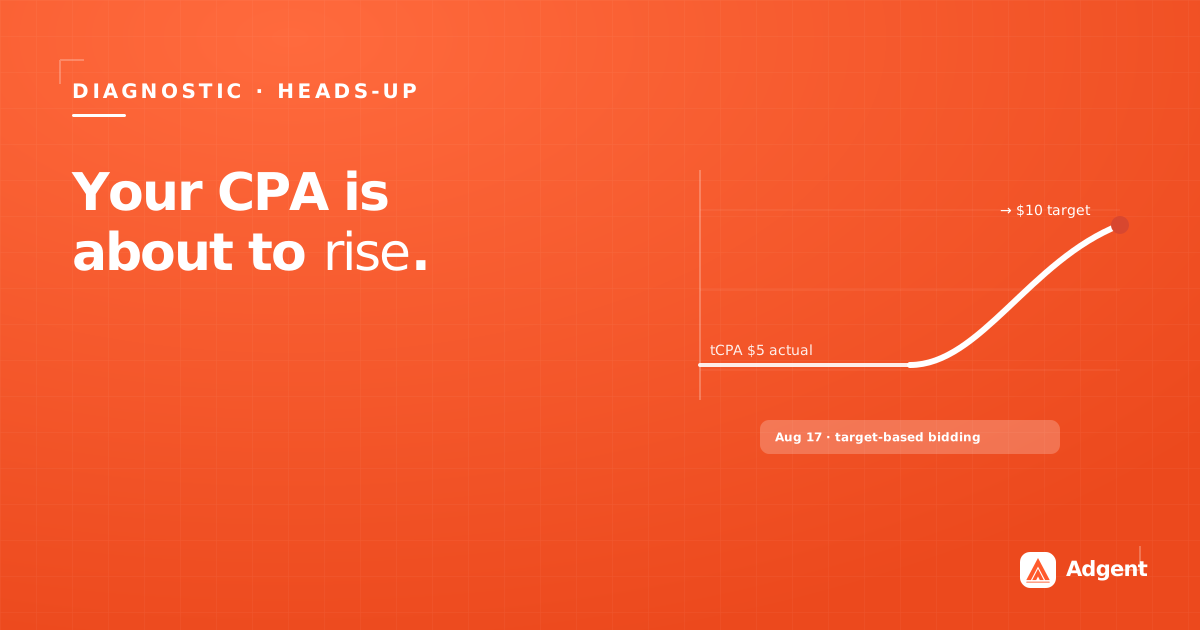
The change went live on 17 August 2026. The checklist below is no longer advance work — it is a catch-up audit, and the diagnostic section at the end is the part that matters most: a CPA that has settled closer to target since the 17th is the platform following instructions, not a campaign breaking.
Since 17 August 2026, Google makes budget-limited campaigns on target-based bidding perform more consistently toward the target you set. If your campaigns had been beating their target — actual CPA sitting below your Target CPA — the change lets Google spend up to the target, which raised your actual CPA and your spend. Audit your targets now.
Most Google Ads changes are quiet — a label moves, a report gets a new column, nobody notices. This one wasn't. On August 17, 2026, Google changed the mechanics of target-based bidding in a way that lifted actual CPA on a large number of accounts, and it happened whether or not anyone touched a setting. If your CPA "jumped" in late August, this is very likely why — and it wasn't your campaign breaking. It was the rules changing underneath it.
The frustrating part is that the accounts most affected are often the well-run ones — the ones that were quietly beating their targets. So before you spend a morning hunting for a broken pixel, understand what actually moved.
What changed on 17 August
Google's own framing is that target-based bid strategies make budget-limited campaigns perform more consistently toward the target you set — including after budget adjustments. Before the 17th, a campaign constrained by budget could drift well under its target because Google wasn't pushing to fill every dollar toward that goal. Now it does. The strategy steers delivery back up to the target you've told it to hit.
The clearest way to see it is Google's own example:
If your Target CPA is $10 but recent actual CPA is $5, after August 17 the campaign will deliver closer to a $10 actual CPA if you make no changes.
Read that again, because the direction matters. A campaign that was acquiring conversions at $5 against a $10 target wasn't underperforming — it was outperforming, comfortably. The change told Google to stop leaving that room on the table and instead spend up toward the $10 you set. Your acquisition volume may rise, but so does the price you pay per acquisition, and so does total spend. The number you set as a ceiling became, in effect, the number Google aims for.
Alongside the mechanics, Google renamed the strategies. "Maximize conversions with a Target CPA" becomes simply "Target CPA", and "Maximize conversion value with a Target ROAS" becomes "Target ROAS". Same underlying strategy, cleaner label — but the label change is a good reminder to go look at what the target is actually set to.
Who this hits hardest
The single biggest tell is the gap between your target and your real delivery. If your actual CPA has been sitting comfortably below your Target CPA — or your actual ROAS comfortably above your Target ROAS — you'd been leaving delivery on the table, and the change is designed to fill exactly that gap. The bigger the gap, the bigger the move you saw.
Budget-limited campaigns feel it most sharply. They're the ones where Google now has explicit room to spend up toward the target after adjustments, so the effect concentrates there. If you run tight daily budgets on Search, Shopping, Performance Max, or Demand Gen with a target-based strategy, assume you're in scope. The change applies across Search, Shopping, Performance Max, Demand Gen, and also Display, Hotel, and Travel campaigns using Target CPA or Target ROAS.
Accounts already delivering right at their target won't see much — there's no gap for Google to close. It's the outperformers, the accounts that set a target with headroom and then beat it, who got the surprise.
Why your CPA looked like it "jumped" — but nothing broke
Here's the diagnostic trap. Someone opens the dashboard in late August, sees CPA up thirty or forty percent, and starts pulling levers — pausing campaigns, cutting budgets, blaming the creative. None of that is the right response, because none of that is the cause. This is a settings and system change on Google's side, not a campaign problem. The funnel didn't break. The auction didn't turn. Google changed what your target means.
That distinction is the whole game. A CPA rise that comes from the auction, a tracking break, or creative fatigue demands one kind of response — and a rise that comes from a bidding-rule change demands a completely different one. If you can't tell them apart, you'll react to the wrong thing. For the general version of that diagnosis — the four usual causes of a CPA spike and how to rank them — see why did my CPA suddenly jump. This change is a fifth cause worth adding to that list for the back half of 2026: the target itself moved.
What to do now
The window to prepare has closed; the tool has not. Google's Bid Target Adjustment Tool, available since 6 July 2026, still lets you review and reset targets by hand. Here's the short checklist:
- Audit target vs. true break-even. Compare each Target CPA / Target ROAS against the most you can actually afford to pay — not your comfortable recent actual. If your target was set with slack, that slack has already become spend.
- Use the Bid Target Adjustment Tool. If you don't want the higher CPA, lower your Target CPA (or raise your Target ROAS) to your real ceiling now, rather than leaving Google to spend up to a loose target.
- Flag your budget-limited campaigns. These move most. Know which campaigns are capped — that's where the CPA rise concentrated.
- Don't panic-edit now. If CPA rose after the 17th, resist reworking bids and budgets in a hurry — big edits reset learning and cost you more. If you do need to scale, do it deliberately: scale a winner without breaking it.
The one decision that matters is whether your target is a real ceiling or a loose placeholder. If it's your genuine break-even, leave it — the change is bringing delivery up to a number you can live with. If it was set once and forgotten, fix it — Google is already acting on it.
The honest read
A number moving because Google changed the rules is precisely the kind of thing that should get flagged, not reacted to. That's the Trust Gate view we build around: before anyone touches an account, the first job is to explain why a metric moved. A CPA up in late August isn't automatically a fire — if it lines up with the 17th, your campaigns are target-based, and actual CPA moved toward your target rather than past it, the cause is this change, full stop.
That's exactly the reasoning an AI media buyer is built to do — read the account, notice the date, and hand you "this CPA rise is the August-17 bidding change, not your campaign," with the evidence attached, instead of an alert that sends you pausing things that were working. If you want that read on your own account now the change has landed, request a demo — one real finding on your own account, before you change anything.
You can read Google's own announcement of the change in the Google Ads Help Center.
Frequently asked
What changed with Google Ads Target CPA on August 17 2026?
Will this raise my CPA?
Which campaigns are affected?
What is the Bid Target Adjustment Tool?
Should I lower my Target CPA now?
Is my CPA jump a bug or this change?
Do I need to do anything if my CPA already matches my target?
Adgent reads Meta and Google accounts overnight and hands you one brief each morning — the diagnosis, the evidence from your own account, and a change you approve before anything writes. Read-only by default. It analyzes creative; it doesn't make it. A target the account cannot reach gets refused before the budget moves, with the account’s own numbers as the reason — the Trust Gate.