
Why Performance Max isn’t spending your full budget
You set the budget, the campaign is live, and it's spending a fraction of the cap. Before you touch the budget slider — it's probably not the budget. Here's how to diagnose the real constraint, ranked by how often it's the culprit.
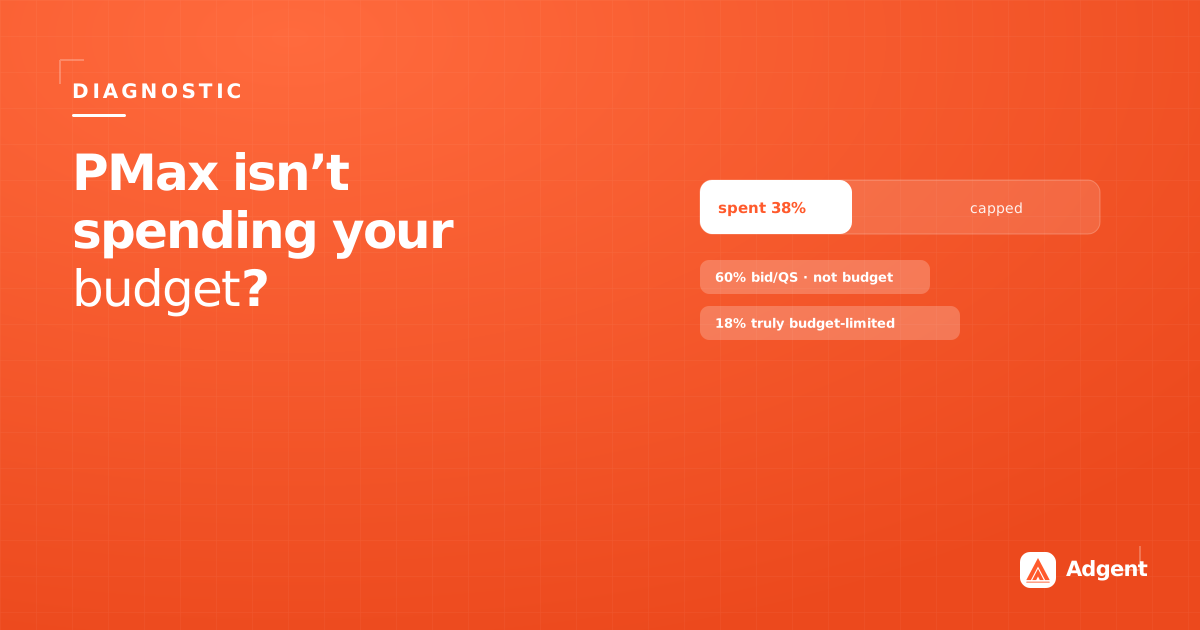
Most of the time it isn't a budget problem. Far more often, a bid target or Quality Score constraint is choking delivery — genuinely budget-limited cases are the minority. Check in order: bid targets too aggressive, learning phase, asset approvals, thin signals, shared-budget cannibalization, then broken conversion tracking. Loosen the target before you raise the budget.
"Performance Max isn't spending my budget" is one of the most common panics in a Google Ads account — and one of the most misdiagnosed. The instinct is to raise the budget, or to assume the campaign is broken. Both are usually wrong. A PMax campaign that under-delivers is almost always telling you something specific about its bid targets, its learning state, or its inputs — and the fix depends entirely on which one.
So treat this as a diagnostic, not a checklist to blast through. Work the causes in order of likelihood, confirm each one before you act, and change one thing at a time. Here's the ranked list.
A campaign that won't spend is rarely short of budget. It's short of auctions it's allowed to win.
First: is it actually a budget problem?
Before anything else, read the campaign status. Google labels a campaign "Limited by budget" only when it genuinely wants to spend more than the cap allows. If your status reads eligible, limited by bid strategy, or shows a learning notice, the budget is not your bottleneck — and raising it will do nothing except sit unspent.
This is the whole point. In the accounts we read, "PMax isn't spending" resolves to a bid or Quality Score constraint far more often than to the budget itself — truly budget-limited cases are the minority. The rest split across approvals, tracking, and thin inputs. If you skip the status check and go straight to the budget, you're fixing the wrong thing on most campaigns.
1. Bid targets too aggressive (the most common cause)
This is the one to check first, because it accounts for the largest slice. A tight Target ROAS or Target CPA tells Smart Bidding to only enter auctions it can win profitably at that target. Set the target too high — or too low a CPA — and the algorithm walks away from most of the auction. The result looks exactly like a budget problem: spend flatlines well under the cap. It isn't. The campaign is behaving as instructed; you instructed it to be picky.
The fix is counterintuitive: loosen or remove the target and let it learn. Start with "Maximize conversions" (or "Maximize conversion value") with no target, let the campaign gather data and find volume, then introduce a target gradually once you can see what CPA or ROAS it actually achieves. Setting an aggressive target on day one is asking the system to optimize against a number it has no data to hit yet.
- Status reads "limited by bid strategy" or eligible, not "limited by budget."
- Your Target CPA sits below your recent historical CPA, or your Target ROAS above recent achieved ROAS.
- Fix: drop the target, run Maximize conversions, reintroduce the target after 2–3 weeks of data.
2. You're still in the learning phase
For the first 7–14 days after launch — or after any significant edit — PMax delivers slowly and conservatively while Smart Bidding calibrates. Under-spend during this window is expected, not broken. The trap is impatience: you tweak the budget, then the target, then the assets, and each edit resets the learning clock, so the campaign never gets a clean run to ramp.
The discipline here is the same one that keeps a winning campaign winning: batch your changes, then leave it alone. If you're mid-learning, the right move is often to do nothing for a week. We wrote the full version of this in how to scale a winner without breaking it — the mechanics of editing without resetting learning apply directly to a campaign that's still trying to find its feet.
3. Ad review delays and disapproved assets
New asset groups go through review, which typically takes up to 24–48 hours and can run longer. Until assets are approved, they can't serve — so a brand-new campaign that isn't spending may simply be waiting. Worse is the silent case: some assets are disapproved (policy, trademark, low-quality landing page) while others are approved, so the campaign serves in a starved, partial state and never reaches the channels the disapproved assets would have unlocked.
Check the asset group status and the policy column. A single disapproved video or a rejected final URL can quietly cap delivery on YouTube or Display while Search chugs along, making the total look like a mysterious under-spend.
4. Narrow audience signals or thin asset groups
PMax uses your audience signals as a starting hint and your assets as the raw material to assemble ads for every channel. Give it too little of either and it has nothing to work with. A thin asset group — one headline variant, no video, a single image — can't build a YouTube or Display ad at all, so those channels stay dark and delivery concentrates on the one or two it can serve. Similarly, a narrow or empty audience signal gives Smart Bidding a weak cold-start.
- Fill every asset slot: multiple headlines, descriptions, images, and at least one video (Google will auto-generate a poor one if you don't — supply your own).
- Add strong audience signals — your customer lists, high-intent custom segments — so the system has a warm start, not a cold one.
5. Shared-budget cannibalization with Search
If PMax and your Search campaigns sit in a shared budget pool, PMax can starve Search — or the reverse can mask what's really happening. PMax has broader auction access than a standard Search campaign: it can serve across Search, Shopping, YouTube, Display, Gmail and Discover, so in a shared pool it often out-competes Search for the same money. The pool drains, and it looks like one campaign "won't spend" when really another is eating the budget.
The fix is structural: give PMax and Search their own separate budgets so neither can cannibalize the other. This is the flip side of a problem we covered in depth — when PMax quietly absorbs your brand traffic and inflates its own numbers at Search's expense. If that's your situation, read Performance Max brand cannibalization for how to detect and fence it off.
6. Broken conversion tracking
This one is last by frequency but first by damage. Smart Bidding spends toward conversions it can measure. If your conversion tag is broken, double-firing, mapped to the wrong conversion action, or reporting zero, the algorithm has no signal to optimize against — so it does the safe thing and pulls delivery back. From the outside it looks like a budget or bid problem; underneath, the campaign is flying blind.
Before you conclude anything else, confirm conversions are firing cleanly and landing on the right action. If you're not sure how to check end to end, our Google Ads account audit walkthrough covers the tracking checks that catch this — a mis-configured conversion event is one of the most common reasons a healthy-looking campaign refuses to spend.
The diagnostic tool: the Channel Performance report
You don't have to guess which of these it is. Open the campaign, go to Insights, and read the Channel Performance report. It breaks delivery down by Search, Shopping, Display, YouTube, Gmail and Discover — so you can see, directly, which channel is silent.
That silence is the tell. A dark YouTube row usually means a missing video asset or a disapproval. A dark Shopping row points at feed or Merchant Center issues. Broad silence across everything but Search points back at the bid target or the learning phase. The report turns "it won't spend" from a mystery into a specific, addressable gap.
Work it in order — and change one thing at a time
The mistake that keeps campaigns stuck isn't missing a cause; it's fixing three at once, resetting learning, and losing the ability to tell what worked. Read the status. Check the target. Give it time. Confirm approvals and tracking. Read the Channel Performance report. Change one variable, then wait for the campaign to respond before you touch the next.
This is exactly the kind of ranked, evidence-first diagnosis an AI media buyer is built to do. Instead of you eyeballing six possible causes, it reads the account, identifies which constraint is actually binding, ranks the fix by impact, and shows its work — the status flag, the target gap, the silent channel. If you want that run against a real PMax campaign, our Performance Max audit guide shows what a full read looks like, or you can request a demo and see what it says about yours — one real finding on your own account, before you change anything.
Frequently asked
Why is Performance Max not spending my full budget?
Is it a budget problem or a bid problem?
Does a tight tCPA or tROAS limit spend?
How long is the PMax learning phase?
Does Performance Max steal budget from Search?
How do I see where PMax is spending?
Can broken conversion tracking stop PMax spending?
Adgent reads Meta and Google accounts overnight and hands you one brief each morning — the diagnosis, the evidence from your own account, and a change you approve before anything writes. Read-only by default. It analyzes creative; it doesn't make it.