Weekly PPC report template: from results to decisions
A reusable review for one brand: last week's commitments, comparable results, unresolved questions and the work due next. Copy it into your existing document or spreadsheet.
Adgent · Paid-media reporting
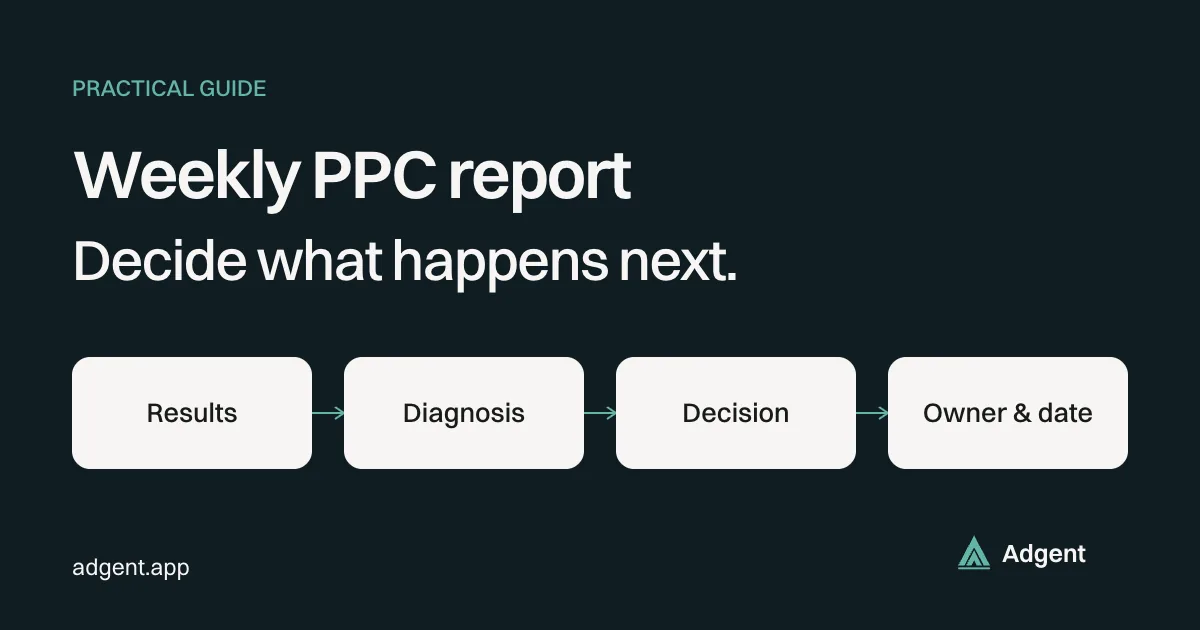
A client can read that CPA rose and still leave the meeting unsure what happens next. A useful weekly report makes the next decision possible. It also preserves the reason for leaving something alone, so the team does not reopen the same argument next week.
Copy this weekly PPC report template
Use these headings in a shared document. The bracketed fields are for your own account data. Keep detailed exports as linked evidence, with their filters saved.
- Report scope. Brand [name]; reviewer [name]; reporting period [start to end, inclusive]; comparison [start to end]; timezone [zone]; currency [code]; extracted [date and time]; data current through [date].
- Decision summary. Business goal [outcome]; current assessment [on track / concern / not yet assessable]; proposed decision [specific action or hold]; reason [evidence]; unresolved dependency [question and owner].
- Last week's commitments. For each decision ID: [promised work], [named owner], [done / blocked / still measuring], [completion date], [evidence link], [what remains].
- Performance scorecard. For each channel and objective: [spend], [defined conversion count], [CPA or ROAS], [previous value], [absolute and relative change], [agreed target], [maturity note]. Add business outcomes separately.
- Explanation. Observed change [fact and source]; possible cause [hypothesis]; supporting breakdown [campaign, query, device or creative]; alternative explanation [what else fits]; next check [evidence needed].
- Constraints and data issues. Record promotions, stock, sales capacity, tracking changes, attribution settings and missing information that affect the decision.
- Next commitments. Decision ID [ID]; action [exact scope]; owner [person]; approver [person if needed]; due [date]; next review [date]; success or stop condition [account-specific rule].
For an agency, add the client input needed before work can start. In-house, name the colleague responsible for the dependency. “Waiting for sales” is less useful than “Maya to supply rejection reasons by Tuesday.”
Fix the period and metric definitions first
Compare complete weeks with the same weekdays. A Monday-to-Sunday report should not quietly compare with the preceding seven days ending on Friday. If a promotion or holiday makes the previous week unusual, retain that comparison and add a relevant baseline with its dates.
Write down whether results use ad-interaction date, conversion date or lead-created date. Google's primary conversion columns assign results to the click date; its “by conv. time” columns use the date the conversion occurred. These answer different questions, as explained in Google's conversion reporting documentation.
- CPA: included spend divided by the specified conversion count. Name the event, such as a submitted form or purchase. A lead CPA is not a customer acquisition cost.
- ROAS: attributed conversion value divided by spend. State whether the value represents purchase revenue or an assigned lead value; document refunds, tax and shipping treatment.
- Conversion rate: conversions divided by the stated denominator. Clicks, eligible interactions and sessions are different denominators.
- Qualified-lead rate: qualified leads divided by eligible leads from the same lead-created cohort, using a documented qualification rule and assessment cutoff.
Calculate aggregate ratios from their underlying totals, not by averaging campaign CPAs or ROAS values. Show counts alongside rates. When the denominator is zero, use “not calculable,” not zero. If the previous value was zero, report the absolute change instead of an invented percentage increase.
For pacing, compare spend to the agreed plan through the cutoff. A straight-line monthly projection is only a forecast assumption; scheduled promotions or deliberate front-loading can make it inappropriate.
Separate recent delivery from mature conversion results
Last week's spend may be complete while its conversions are still arriving. Google explicitly warns that this can make recent CPA appear higher because spend is reported before later conversions. Use the account's Days to conversion report or bid strategy delay information to assess that lag.
Keep two views: the latest complete week for delivery and immediate problems, and an older evaluation period chosen using observed conversion delay. Label recent CPA and ROAS provisional when appropriate. Do not invent a universal waiting period or conversion-count threshold.
Save each report's extraction date. When an older period gains conversions, record the revision beside the originally reported result. Where snapshots exist, compare periods at a similar age; otherwise disclose that the older period has had longer to mature.
For lead generation, separately track time to qualification and time to sale. Sales closed this week may come from leads acquired months ago. Dividing those sales by this week's leads does not produce a cohort close rate. If lead volume and sales disagree, use the lead-to-sale diagnosis before changing bids.
Report Google and Meta without double-counting success
Keep Google and Meta attributed conversions and revenue in separate rows. A customer may see a Meta ad, click a Google ad and buy once. Adding both platforms' claimed revenue does not establish unique business revenue.
Record each row's event and attribution settings. Meta's Ads Action Stats documentation distinguishes click, view and engaged-view windows. Do not assume every row uses the same basis, or add overlapping click windows together.
Add a separate business row from deduplicated orders or CRM records. State the source, date basis, coverage and treatment of cancellations. Total spend can be combined after currency and period alignment. Business revenue divided by that spend is a blended business ratio, not proof that advertising caused all that revenue.
Neither a higher attributed ROAS nor a better weekly blended ratio establishes incrementality. To answer what would have happened without the advertising, plan a suitable controlled experiment separately. If records cannot be matched, leave the discrepancy unresolved and assign its investigation.
Write a decision log someone can act on
A decision needs an owner even when the decision is to wait. Record the evidence that would change it, plus the date someone will look again.
A lead-quality decision
If an export shows more forms but the sales team has not finished assessing those leads, a possible decision is to hold the non-brand Search budget within the agreed spend limit while checking quality. Record the cohort and the missing qualification outcomes as the reason.
Name the person who will supply those outcomes and the reviewer who will compare them with the same cohort. Give each a due date. Set the next review before proposing a budget change; if the evidence is still incomplete, record the missing input and assign the next check.
Also record what would reopen the decision early, such as a tracking failure or a breached spend limit. A decision to wait still needs an owner and a condition for acting.
For an actual change, also record the affected campaign, old and proposed settings, expected effect, implementation timestamp and stop condition. “Improve performance” is not a completed task. “Review search terms and submit exclusions for approval” has an observable finish.
Run the review from last commitment to next action
Open the meeting with unresolved commitments. Confirm what shipped and what remains blocked before discussing fresh numbers. Then read the decision summary and inspect only the breakdowns needed to accept, reject or amend it. A sharp CPA movement can use the CPA diagnosis checklist as its investigation path.
Close by reading each new commitment aloud: action, owner, due date and next review. Save the agreed version and its evidence links. At the next meeting, begin there. A spreadsheet and a shared document are enough to run this process.
Adgent can help with one brand's recurring review by bringing account evidence and confirmed business context into the discussion, then carrying the agreed direction into reports and execution plans. Use the same template to judge whether that work is useful.
Frequently asked
How long should a weekly PPC report be?
What if there are too few conversions for a weekly conclusion?
Should every weekly report propose a campaign change?
Can I total Google and Meta revenue in the report?
Bring one brand's weekly report and an unresolved decision. See how Adgent carries the account evidence and team discussion into the next piece of work.
Request a demo