
Can AI audit your ad accounts?
Yes — and for the tedious, high-volume checks it's genuinely better than a human. But an audit is more than a checklist, and there's a ceiling where judgment takes over. Here's an honest split of what AI catches and what it still misses.
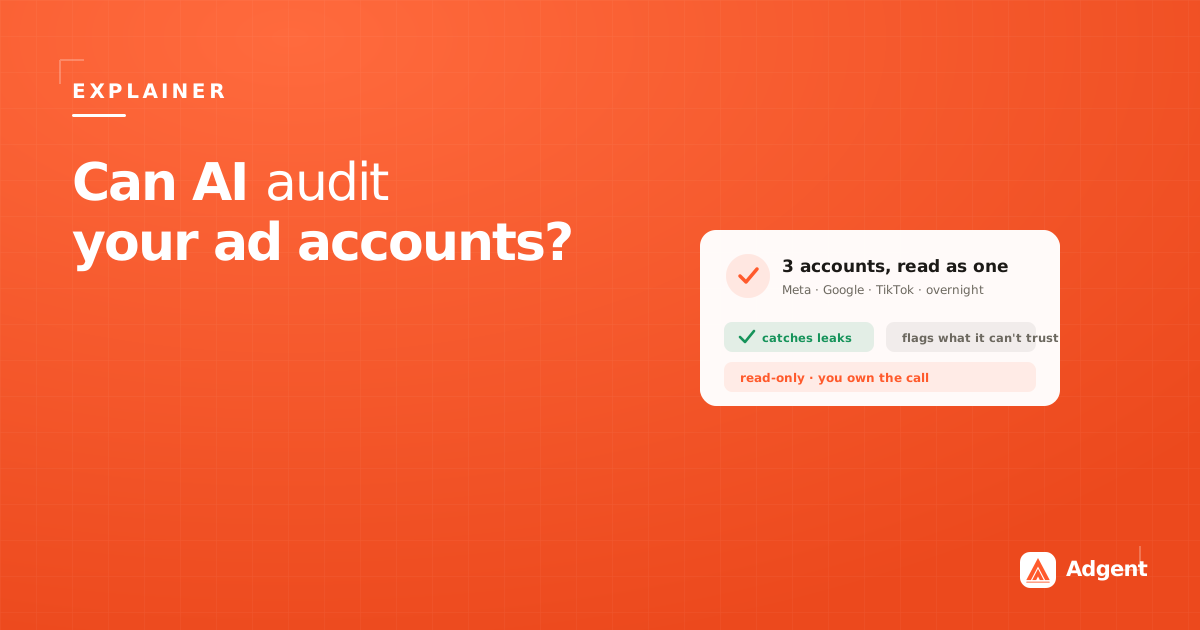
Yes — there is AI that audits ad accounts. It reads Meta and Google through their APIs, runs the same checks a senior buyer would — wasted spend, placement leakage, tracking gaps, ROAS drift — and ranks findings by recoverable spend, in minutes instead of hours. It's strongest on the tedious, high-volume checks and on reading Meta and Google as one account. Where it hits a ceiling is judgment: the strategic call, the business context, deciding whether an ambiguous number is real. A good audit AI stays read-only and surfaces the finding; a human still owns the interpretation.
"Is there an AI that audits ad accounts?" Yes, and the honest version of that answer is more useful than the marketing version. AI does part of an audit better than any human and part of it not at all — and knowing the line is what lets you actually trust the output. So let's draw it: where AI genuinely helps, and where it hits a wall.
Where AI genuinely helps in an audit
An audit is mostly reading — every campaign, ad set, placement, search term and conversion setting, looking for the leaks. That's high-volume, rule-based, tedious work, and it's exactly where AI outperforms a tired human on the fortieth ad set.
- Wasted spend. Wasted search terms, leaked placements, duplicate retargeting, budget stuck in something that stopped converting — the line-item leaks that reopen week after week. AI reads all of them, every time, without skimming.
- Cross-platform reading. Meta and Google as one account instead of two tabs — the reconciliation between platforms is where a manual audit gets slow and error-prone. Run it over several accounts and each one is still audited on its own, then listed by what needs you first.
- ROAS leaks hiding in the average. A healthy blended 3.8× can conceal a placement bleeding at 1.1×. AI decomposes the average and finds the leak the summary number hides.
- Tracking gaps. A broken pixel, a double-counted event, a mis-configured conversion — measurement problems that quietly poison every downstream decision. Flagging these is often the single most valuable thing an audit does.
- Ranking by recoverable spend. Not a 40-item report of everything, but the handful of findings that actually move money, ordered by impact. That prioritization is genuine analysis, not just detection.
And unlike a one-off audit, AI keeps the read current. The high-drift checks — wasted terms, placement leakage, pacing — change week to week, so a continuous read beats a scheduled review that's stale the day after it's delivered. For the full manual version of these checks, see the Google Ads audit checklist.
The detection is where AI wins. The interpretation is where it needs you.
Where AI hits its ceiling
This is the part the hype skips, and it's the part that earns trust. An audit isn't only a leak hunt — some of it is judgment, and judgment is where AI stops.
- Business context it can't see. A "wasteful" campaign might be a deliberate brand play, a promo period, or feeding an offline conversion the API never reports. AI flags the anomaly; only you know it was intentional.
- Strategic calls. "Is this even the right channel mix?" or "should we be on this platform at all?" are questions above the account. An audit reads what's there; it doesn't decide the strategy that put it there.
- Untrustworthy numbers. Yesterday's ROAS is still revising inside its attribution window; a confident-looking metric can be fiction from a broken tag. AI can flag that a number isn't safe yet — but the final call on whether it's real enough to act on stays human. More on that in why day-one data lies.
- The fix on live spend. Finding the leak and committing the change are two different acts. An audit should surface and propose; a human should approve anything that touches real budget.
None of this makes AI a weak auditor. It makes it a partial one — the right partial, if you point it at detection and keep the human on interpretation.
"Is the pixel installed" is not "is the pixel useful"
One tracking check deserves separating out, because most audits stop one question short of it. Confirming a pixel is installed and firing is a green tick. Whether it produces a signal an optimizer can actually learn from is a different question, and the answer can be no while every tick stays green.
A real account we read shows the gap. Thirty days of pixel data looked busy: 65,042 custom events, 16,404 initiate-checkouts. Installed, firing, plenty of volume. Then the row that matters — 4 purchases. Meta's optimizer needs 50 events in 7 days to get out of the learning phase. Four in a month isn't a thin signal; it's below the floor where a conversion campaign can learn anything at all.
Installed and firing is a tracking check. Whether the event that pays fires often enough to train on is a signal-quality check. An audit that only does the first one hands you a green tick over an account that cannot optimize.
The useful finding wasn't "your pixel is broken" — it wasn't. It was that the setup is technically possible while the learning signal isn't there yet, which points at fixing the purchase event before building anything that optimizes toward it. That check costs nothing to run before spend and is expensive to discover after. Worth asking of any audit, human or automated: does it read the conversion counts against what the platform needs to learn, or does it stop at "firing"?
Catches vs. misses, side by side
| Audit task | AI catches it | Human still owns it |
|---|---|---|
| Wasted search terms & placements | ✓ | n/a |
| ROAS leaks inside a blended average | ✓ | n/a |
| Tracking & conversion gaps | ✓ | confirms |
| Reading Meta and Google as one account | ✓ | n/a |
| Is a flagged number trustworthy yet? | flags | ✓ |
| Business context behind an anomaly | — | ✓ |
| Strategy & the right channel mix | — | ✓ |
| Approving the fix on live spend | — | ✓ |
Read down the highlighted column and the split is clean: AI owns detection at scale; the human owns context, trust and the final call.
What a good audit AI looks like — the Adgent example
To make it concrete, here's how we've built the audit into Adgent. Overnight it reads Meta and Google as a single account, pulls GA4 and Search Console in for context, and by morning hands you one brief ranked by recoverable spend — not a 40-page report, the few findings that move money. It reconciles each platform's numbers against actual revenue, so a ROAS the platform is proud of gets checked against what the business actually booked.
Two design choices carry the trust. First, it's read-only by default: the audit reads and reports, and every proposed fix is a drafted, approval-gated action — the owner approves changes, and nothing writes to a live account on its own. Second, it's honest about its ceiling: when a number is still inside its attribution window or looks like it's coming from a broken tag, it says so rather than ranking it as fact. An audit that hides its own uncertainty isn't an audit; it's a guess with formatting.
So — is there an AI that audits ad accounts? Yes, and the good ones are frank about the line: they catch the leaks a human would miss on the fortieth ad set, and they hand the judgment calls back to you. If you want to see what one finds in a real account, request a demo — one real finding on your own account, before you change anything. It'll read every account, one at a time, and rank what it finds. You keep the call.
Frequently asked
Is there an AI that audits ad accounts?
Can AI audit a Google Ads or Meta Ads account?
What can AI catch in an ad account audit?
What can't AI catch in an ad account audit?
How long does an AI ad account audit take?
Is it safe to let AI audit my ad account?
Can AI audit multiple ad accounts at once?
Adgent reads Meta and Google accounts overnight and hands you one brief each morning — the diagnosis, the evidence from your own account, and a change you approve before anything writes. Read-only by default. It analyzes creative; it doesn't make it. The overnight read, ranked by what each finding costs, is the daily verdict.