
Google Ads account structure in 2026 (and how to audit yours)
The old rules of structure were about manual control. In 2026 they're about signal quality — building an account so Smart Bidding has enough clean conversion data to actually learn. Here's the modern default, and how to audit whether yours measures up.
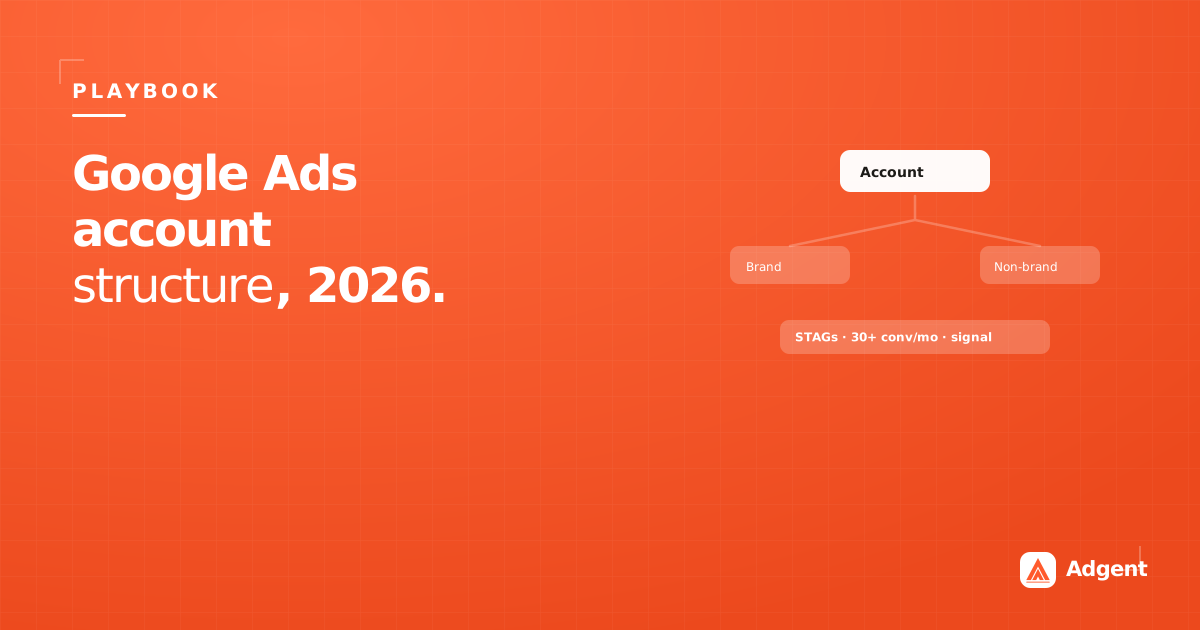
In 2026, Google Ads structure is about signal quality, not manual control — give Smart Bidding enough conversions per unit to learn. The modern default: Single Theme Ad Groups (STAGs) of 3-10 tight keywords, a Brand / Core Non-brand / (optional) Competitor campaign split, and 30+ conversions per month per campaign so bidding has signal. Structure to feed the algorithm, not to fight it.
For fifteen years, account structure was how you controlled Google Ads by hand. You split campaigns to control budgets, split ad groups to control bids, and the buyer with the most granular structure usually won. That advice is now actively wrong. Smart Bidding sets the bids; your structure's only job is to feed it clean, concentrated signal. Build for that and you win. Build the old way — a hundred single-keyword ad groups, a campaign per product — and you starve the algorithm across so many thin units that it never learns.
So this is the 2026 default, framed the way we think about it at Adgent: not just how to build the structure, but how to audit whether yours is right. Because most accounts we read weren't built wrong on purpose — they were built correct for 2018 and never re-cut for how bidding works now.
The hierarchy, and what each level is for now
The four levels haven't changed. What each one is for has changed completely:
- Account. The billing and conversion-tracking boundary. One conversion action set, one source of truth. This is where signal is defined — if your conversion tracking is wrong here, nothing below it can be right.
- Campaign. The bidding unit. This is where budget lives and where Smart Bidding learns. The campaign is now the thing you must feed with enough conversions — it's the level the algorithm optimizes against.
- Ad group. The relevance unit. Its only remaining job is keeping keywords, ads and landing page tightly matched — it no longer controls bids at all. This is where STAGs live.
- Ads & keywords. The message and the trigger. Keywords tell Google what intent you want; responsive search ads answer it. Quality Score still rides on how well the two align.
The shift in one line: campaigns are for bidding, ad groups are for relevance. Every structural mistake in 2026 is really a confusion of those two jobs — either splitting bidding units so fine they can't learn, or lumping unrelated intents into one ad group so no ad can answer them.
STAGs: the one rule that governs ad groups
A Single Theme Ad Group is exactly what it says: an ad group where every keyword shares one intent. Three to ten keywords, all so closely related that a single ad and a single landing page can answer every one of them. That's not a style preference — it's the mechanism that drives relevance and Quality Score, and Google itself reports that raising ad relevance and landing-page experience is one of the largest levers on Quality Score, which in turn discounts your cost per click.
The rule is a single test, and it's brutal in how it decides:
Every keyword in an ad group must be answerable by the same ad and the same landing page. If you can't write one ad for all of them, the group is too broad — split it.
Take "running shoes." If your ad group holds running shoes, trail running shoes, marathon shoes and waterproof running shoes, ask: can one headline honestly answer all four? It can't. Someone searching "waterproof running shoes" who lands on a generic running-shoe page bounces, and their bounce trains Smart Bidding that the whole group converts worse than it should. Split them into four STAGs, each with its own ad and its own page, and every impression now carries a clean signal.
The 2018 version of this advice was SKAGs — Single Keyword Ad Groups, one keyword each. Close-variant matching killed that: Google now serves your ad on dozens of variants regardless, so a one-keyword group buys you nothing but fragmentation. The STAG is the correction — tight enough for relevance, broad enough that conversions concentrate instead of scattering across a hundred starved groups.
The campaign split: isolate brand, above all
At the campaign level, split by intent, not by product line or geography or anything else that fragments signal. The modern default is three buckets:
- Brand. People searching your name. High intent, high conversion rate, low CPA — a different economy entirely.
- Core Non-brand. Your real prospecting — category and problem-aware searches where the money is actually won or lost.
- Competitor (optional). Bids on rival names. Expensive, low conversion rate — worth isolating so its poor efficiency never contaminates non-brand targets.
The non-negotiable one is brand. Brand searches convert at rates that dwarf non-brand — often several times higher at a fraction of the CPA — because the person already decided to buy from you. Leave brand mixed into non-brand and those cheap conversions flatter the blended average, hiding the fact that your actual prospecting is losing money. Worse, a single target CPA can't serve both economies at once: set it for brand and non-brand starves; set it for non-brand and you overpay for traffic you'd have won for free. Isolating brand is the single highest-leverage structural move in most accounts — the full case for it, including how Performance Max quietly eats brand credit, is in why brand must be isolated from Performance Max.
The signal threshold: 30+ conversions a month, or bidding thrashes
Here's the number that quietly governs everything above. Google's own guidance is that Target CPA wants roughly 30 conversions in the trailing 30 days per campaign before its model is stable, and Target ROAS wants closer to 50. Below that, Smart Bidding is fitting a curve to noise — it over-reacts to a lucky week, pulls back after a random dead Tuesday, and never settles. That's the thrash: bids swinging not because the market moved, but because the algorithm can't tell the difference between signal and randomness on too few data points.
This is why granular structure now backfires. Split one healthy campaign carrying 90 conversions/month into six tidy product campaigns and you've made six units of 15 — all below threshold, all thrashing, all worse than the one you started with. The instinct to organize neatly is exactly the instinct to resist. Consolidate until each campaign clears the threshold, then stop. If you're weighing how to group budgets for this, the mechanics are in CBO vs ABO in 2026; if you're trying to grow a campaign that's already learning without resetting it, see how to scale a winner without breaking it.
Structure for signal, not control — the 2026 shift
Everything above collapses into one mental model, and it's the whole point of this piece. The old question was "how do I structure this so I can control every bid?" The new question is "how do I structure this so the algorithm has the cleanest, most concentrated signal to learn from?"
Those two questions produce opposite accounts. Controlling by hand pushes you toward more units, finer splits, single-keyword groups — maximum granularity. Feeding signal pushes you toward fewer, denser units — enough separation to keep intents clean, enough consolidation to keep every bidding unit above threshold. In 2026 the second account wins every time, because you are no longer the bidder. You're the person who decides what the bidder gets to see.
You don't structure a Google Ads account to control the bids anymore. You structure it to control what the algorithm can learn.
How to audit your existing structure
Now the part most guides skip. You almost certainly already have an account — the question isn't how to build one from scratch, it's whether the one you've got is quietly leaking signal. Run these four checks, in order of how much damage they do:
1. Are any ad groups too broad?
Open your biggest ad groups and apply the STAG test to each: could one ad honestly answer every keyword in here? If the group mixes intents you couldn't write a single relevant headline for, it's too broad — every mismatched impression is teaching Smart Bidding the wrong thing. This is the most common leak and the easiest to fix.
2. Are any campaigns below the conversion threshold?
Sort campaigns by conversions over the last 30 days. Anything under ~30 is a thrashing bidding unit, full stop. It either needs consolidating into a sibling or its bid strategy needs to move up to a portfolio that pools signal across campaigns. Thin campaigns don't just underperform — they degrade.
3. Is brand mixed into non-brand?
Check whether brand terms live in the same campaign as prospecting. If they do, your reported CPA is a fiction — cheap brand conversions are subsidizing losing non-brand targets, and you can't see it. Pull brand into its own campaign and watch the non-brand numbers tell the truth, often for the first time.
4. Is Performance Max overlapping Search?
If you run both, PMax will happily serve on queries your Search campaigns should own — including brand — and take the credit, because it has priority on many query types. That overlap makes both structures unreadable. Two of our deeper walkthroughs cover the full sweep: how to audit a Google Ads account end-to-end, and how to audit Performance Max specifically for cannibalization.
| Structural check | The old rule (manual control) | The 2026 rule (signal quality) |
|---|---|---|
| Keywords per ad group | 1 (SKAG) | 3-10, single theme (STAG) |
| Campaigns per account | Many, granular | Few, above threshold |
| Split campaigns by | Product / geo | Intent (brand / non-brand) |
| Bids set by | You, by hand | Smart Bidding |
| Conversions per campaign | Not a concern | 30+ / month (50 for tROAS) |
Same four levels, opposite instincts. In 2026, granularity is the failure mode.
The close: let something read the whole structure at once
The hard part of a structure audit isn't any single check — it's holding all four in your head at once, across every campaign, and seeing how they interact. A broad ad group inside a thin campaign that's also being cannibalized by PMax is three problems compounding, and a human scanning the UI at 8am rarely catches the compound.
That's exactly the read an AI media buyer is built for: it ingests the whole account structure at once, flags the ad groups too broad to answer with one ad, the campaigns below threshold, the brand bleed and the PMax overlap — ranked by how much each is costing you, with the fix prepared and waiting for your approval. If you want to see what it would say about your structure, request a demo — one real finding on your own account, before you change anything.
Frequently asked
What's the best Google Ads account structure in 2026?
What is a Single Theme Ad Group (STAG)?
How many ad groups per campaign?
Should brand be a separate campaign?
How many conversions does Smart Bidding need?
How do I audit my Google Ads account structure?
Does account structure still matter with AI bidding?
Adgent reads Meta and Google accounts overnight and hands you one brief each morning — the diagnosis, the evidence from your own account, and a change you approve before anything writes. Read-only by default. It analyzes creative; it doesn't make it.